The other thing that I got involved in was educational programs. Education was a great means of developing ideas. Working with a group of students you could develop in a free environment where you could create really radical ideas and models. I was lucky, I got a whole year with a group of students and I created this course where there was no difference between staff and students and all the work was cooperative and collaborative. There was no individual competitive work. Out of that, I remember there was no way in which we could discuss these ideas and externalize them to other artists or anybody like that. We had the feeling that we were going to places that nobody had ever been before, and yet we had no way of externalizing this to other artists and establishing those philosophical models.
That’s really how Control came about. It was through that need, but it was also part of this idea of the Conceptual Designer. If you look at the first issue of Control it was really an artwork, it wasn’t seen as a magazine. You’ve got a purple spot on the cover and a purple spot on the inside. The idea was that you took the purple spot inside, pinned it on the wall, put a chair underneath it and sat there with the magazine, so there was a connection between the two purple spots, the one on the inside of the magazine, which you put on the wall, and the one on the cover of the magazine. It was a kind of philosophical idea.
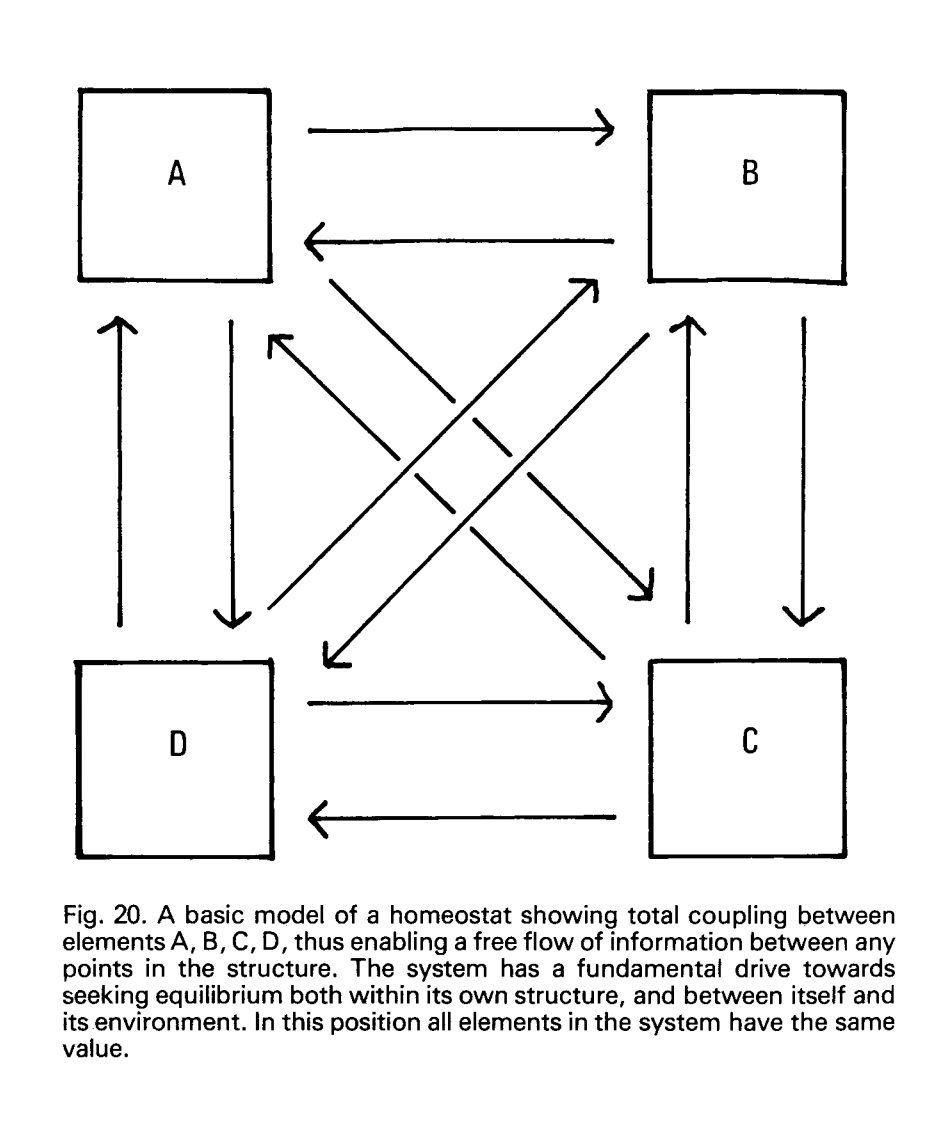
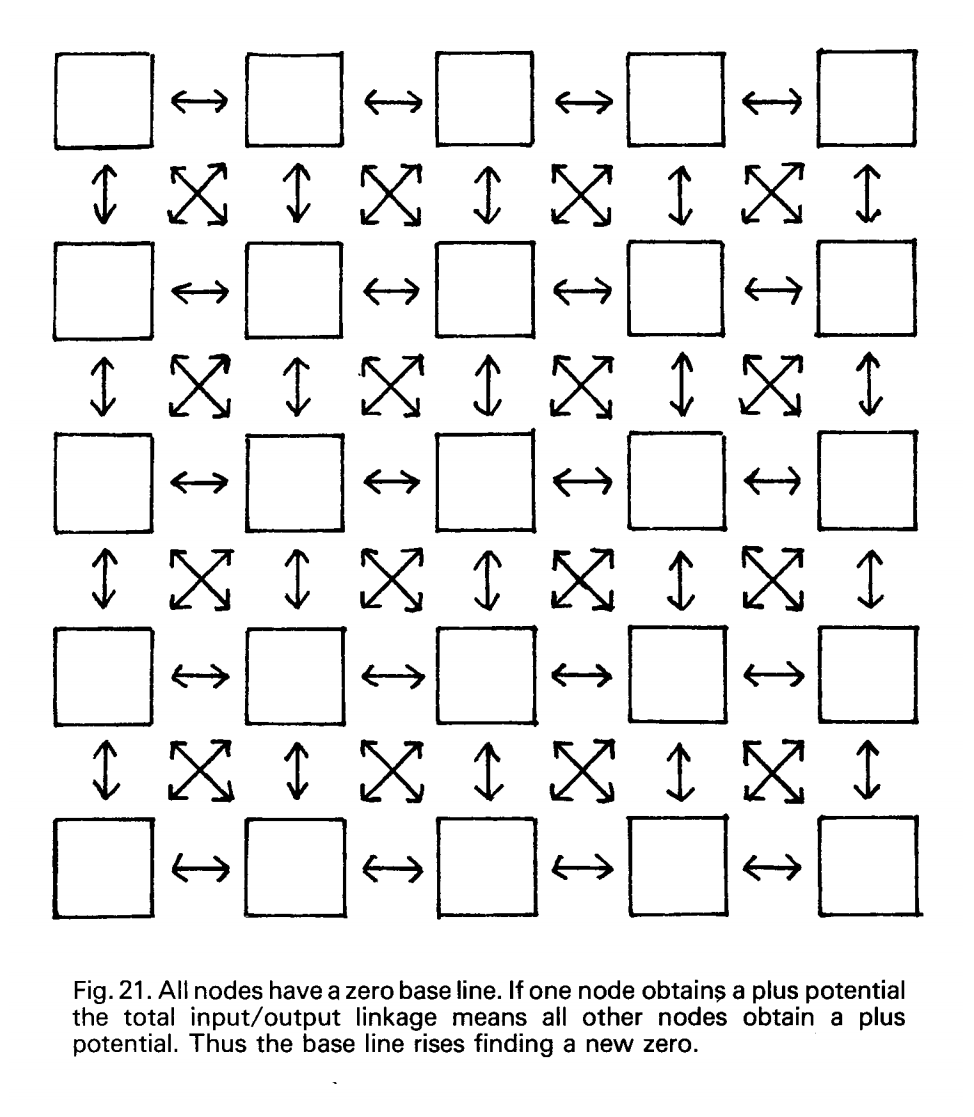
We had all sorts of names that we were thinking of for the magazine, but in the end, I settled on Control because, for one it’s a polemical word, and it’s pivotal in denoting different models of society. For instance, the common idea of control is of a hierarchical, top-down deterministic system, like you might get in the military or something like that. Our society is more or less like that here, but there are other models of control. The control that we were interested in was the idea of self-organizing, homeostatic, one-layer systems. The idea of networks between people. In a way we were entering, shall we say, free flowing, totally flexible models of relationships really, which has got us into a lot of trouble, but anyway…
At that time, in 1965, as an artist, or Conceptual Designer, I was looking at models of advertising. I got very involved in advertising theory, and I thought coupling this with cybernetics was interesting. I mean, you have to think that cybernetics at that time was strongly associated with determinism. The philosophical models developed in the late ‘50s had been appropriated pretty rapidly by all sorts of organizations which had the financial support for development of further ideas. You had this crazy situation when I was at Systems Research, with people developing far reaching speculative models, but the contract they had was with the police or something like that. It was wholly unsatisfactory. But I realized that these same models could be used in quite a different way, to liberate the person. Instead of as a Pavlovian outcome, it could be quite different. In fact, you could connect with learning theory and with advertising theory, especially the idea of multi-channel feedforward heuristics in advertising, which I got involved in, time-based strategies of presenting and acquiring information. Again, these ideas from advertising had a deterministic outcome, but the same theories could be applied to quite a different outcome.
The outcome that I was interested in was the idea of self-organization. Transformation in the self, or creative potential of the self, so that anybody could create their own being in relation to other people. I was interested in society. I see that there’s a richness in relationships between people, community. That was Control magazine, really. It was the idea to set up a mechanism for people to externalize models of their practice in a society, in a community. There wasn’t anything like that around at all.
I managed to get theoretical models out of these advertising agencies. I met a guy called Dean Bradley and he’d come from New York to London. He was associated with the Pushpin agency. He came to London and he wanted to set up an agency here, which he did, it turned into a very well known agency. He became a friend of mine, and he did the graphics for the first issue. Dean was really only associated with issue number one, but then we carried on the same aesthetic for a while.
SH: My second question is about how these ideas of self-organizing systems and flat hierarchies played into your approach to distribution. I notice how you positioned yourself as an editor over the first several issues seems to have evolved. I wonder if you could talk about the idea of distribution and the role of the editor.
SW: In the first issue, there was no mention of an editor’s name or anything. And there was also no date, no address or anything. The idea was that it was free-floating, independent of time. I guess that we were kind of right in that idea, because if you get hold of Control number one it seems just as relevant now as it did when we created it.
This was the idea, but I soon found out that I was contravening all sorts of laws and I could be prosecuted, so I had to put a name and I had to put an address on it. So if you get issue number 2 you’ll find there’s an address, and there’s an editor called Stephen Willats.
That was a legal thing. But then the magazine went through various developments, it evolves, and it is still evolving. The magazine evolves as the world we live in evolves or changes. That period, years one to five, also had its own evolution. Issues number two and three were made up of artist that were groping towards something, but hadn’t quite got there, some of them.
There was a characteristic of this period in the sixties that there was quite a big gap between what people wanted and what they could do. This is not only in art, but also in science. You had the idea in cybernetics of people philosophically postulating different models of organization, but they didn’t have the engineering skills or hardware to replicate those ideas. They could only demonstrate them in a very crude way. For instance, I was building computers in this period, building simulation works, but when I look at the things that I built, they were very simple, very crude, really. But at the time they seemed to demonstrate an idea, or they presented an idea. It wasn’t until the ‘70s, when cybernetics and so on became rather unfashionable, and the engineers of this world picked it up, that things started to really move. It took a long while for the engineering to catch up with the ideas.
And the same was true of artists working. In my opinion, there’s a discrepancy between the manifestation of the art practice and the actual theory—their intention and performance, shall we say. And that’s something, looking back at it, that you can recognize, but at the time we didn’t quite realize it.
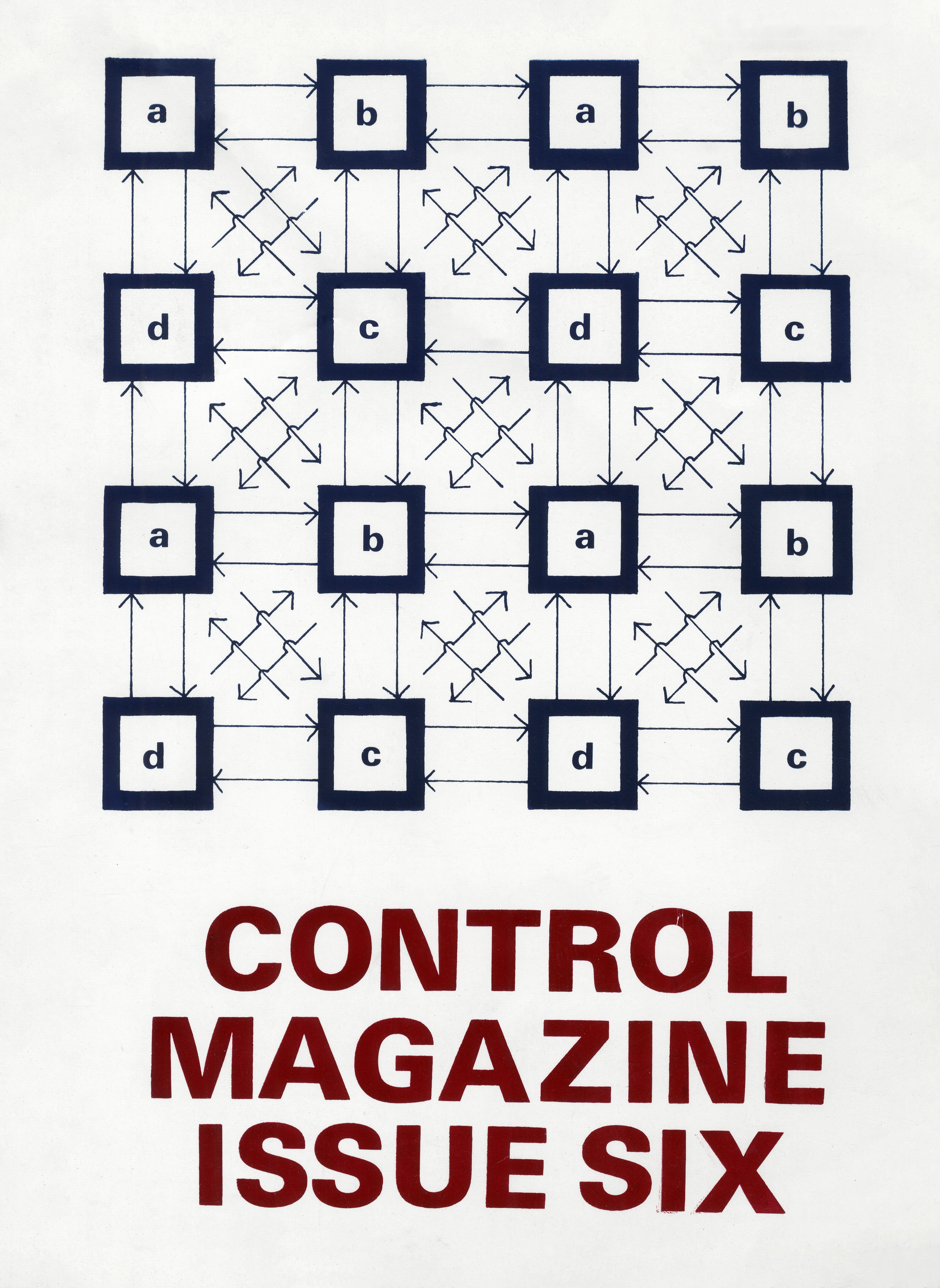
The actual magazine existed within a community of people here in London, but the magazine was, right from the start, totally international. It went throughout the world. In America for instance, it was available through Printed Matter, the Jean Brown Archive, and other places. It went to Europe, it didn’t go to the far East. We printed 500 copies, there’s 500 people in the world that take Control magazine. Every time we tried to increase it from 500, like when we printed 700, we have still got 150 of that particular issue. Originally, here [in the U.K.] in the 60s and early ‘70s, there grew up a whole network of small bookshops. There were lots of individual bookshops, they’ve all disappeared, they don’t exist anymore because of very high property prices and all the rest of it. The distribution was very ad hoc, but the organization was down to me. I produced it on my own ever since, really. I had help, and some artists came and helped me. The cover was all printed by silkscreen in my studio. It was handmade, really.