
As part of the A+WS library project initiated by AEROMOTO and Wendy’s Subway at the 2015 NADA Art Fair, Avant.org presented a multimedia program of Brazilian concrete poetry and music from artists affiliated with the Noigandres group, ca. 1958-1975. The program was curated by art historian Charles Eppley, editor and programs director for Avant.org, with assistance from Canadian writer Nathaniel Wolfson, who is a Ph.D. candidate, researching Brazilian concrete art practices at Princeton University. Wolfson performed selections of Noigandres poetry, a body of work typically understood visually rather than sonically, so as to emphasize its acoustic potential and pertinence within the development of modern sonic aesthetics. In addition to this performance, selected audio was available on-site via a playlist of Noigandres recordings. The playlist is now available, in full, accompanying this article.
This program was conceived and presented as an accompaniment to A+WS library item #16: Arte Correo (Mexico City: Museo de la Ciudad de Mexico/Editorial RM, 2011). Arte Correo is a collection of archival documents from the mail art and concrete poetry scenes that emerged in Mexico in the 1960s and remained active through the 1980s, offering an under-represented perspective on the global development of conceptual art. Our program seeks to contribute to the research initiated by Arte Correo by highlighting a group of concrete artworks that originated in South America.
Below are selections from the program booklet produced by Avant.org for the event. The booklet was printed by Wendy’s Subway for their site specific micro-library and is now available in their permanent book collection. Additionally, an excerpt from the Noigandres manifesto, Pilot Program for Concrete Poetry (1958), is republished here in English (both English and the original Portuguese versions are published in the A+WS program). Supplementing these documents are audio recordings of original and re-performed Noigandres poems, available in the streaming playlist below.
About the Noigandres
The Noigandres group was one of the earliest artist collectives in the concrete movement, which spanned, not only literature, but also music, painting, and sculpture. Challenging traditions of artistic form and meaning, the concrete movement began in the 1950s by abstracting language, visual form, and their dual comprehension. The Noigandres group, which takes its name from a neologism found in an Ezra Pound poem, was formed in 1952 by the Sao Paolo poets Haroldo de Campos, Augusto de Campos, and Décio Pignitari. The group was later joined by the poets Wlademir Dias Pino, Ronaldo Azeredo, and José Lino Grunewald, among others, culminating in a national exhibition of concrete poetry and painting in 1956. In 1958, the group published their concrete manifesto, Pilot Plan for Concrete Poetry, reprinted below. The collective effectively disbanded following the publication of its final anthology in 1962, thus retiring its name, though the constituent artists would continue to develop their practices individually.
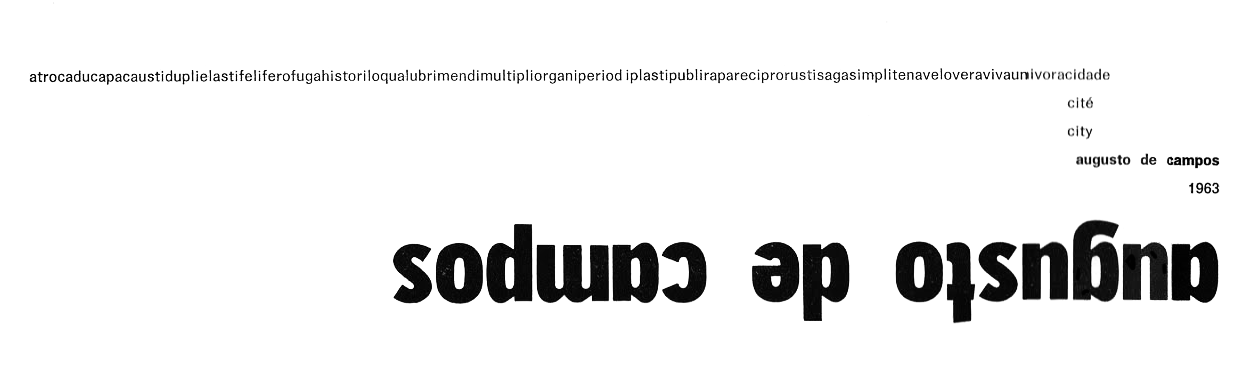
Augusto de Campos, Cidade-Cite-City, 1963
Instead of focusing on linguistic content and poetic symbolism alone, artists affiliated with the Noigandres group interrogated the visual forms of language, mining the spatial arrangements of textual imagery for extra-linguistic meaning. Experimenting with typography, scale, punctuation, organization, and other non-linguistic elements of poetic form, the group synthesized visual form and linguistic meaning in a playful, yet groundbreaking destruction of language and literary aesthetics.
The group formed a concrete poetry journal, Noigandres, to publish their own works, as well as the concretist artworks of other groups such as the Grupo Ruptura, which featured the artists Lygia Clark, Helio Oiticica, Franz Weissmann, and Lygia Pape. The rise of the concrete movement in Brazil was joined by others across the region, extending north towards Mexico and the United States, and was supplemented by the post-colonial influences of movements in Switzerland, Germany, Italy, and France, then represented by artists like Mathias Goeritz and Eugen Gomringer.
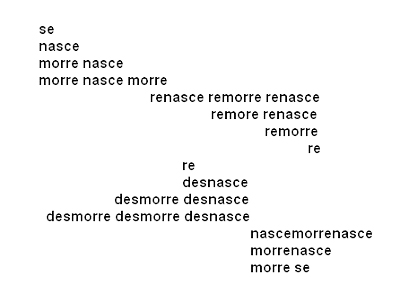
Haroldo de Campos, Nasce Morre, 1958
Although the Noigandres journal was only published between the years of 1952-1962, artists continued developing abstract poetics in following decades. Notably, Augusto de Campos experimented with several forms of multimedia composition and display, including the early use of computers (representing a counterpoint to the development of new media art in North America during the 1970s and 1980s, including the experimental television operas of the composer/librettist Robert Ashley).
The scholarship on Noigandres poetry, where it can be found, has often focused on the visual and literary forms used by the group, and the compositional methods deployed in constructing relationships between text and image (dubbed by the poets as a verbivocovisual language). However, once some concrete poets began collaborating with tropicalia musicians during the mid-1960s, such as Caetano Veloso and Tom Ze, the sonic dimension of their works became clearer.
This program will call specific attention to the sonic potential of Noigandres poetry – and of concrete poetry in general – by performing works that emphasize the complexity of range and tone in the human voice, preceding and following the tropicalia influence. In the past, readings of this material have been accompanied by orchestral and electronic music (e.g., musique concrete), and several of the poets helped set their texts to abstract sound and/or scored music. A selection of these recordings are included as an audio playlist available in the A+WS Library, and online at Avant.org. In addition to the recordings made by Noigandres artists, the playlist includes other interpretations from the 1970s and beyond.
⸺ Charles Eppley
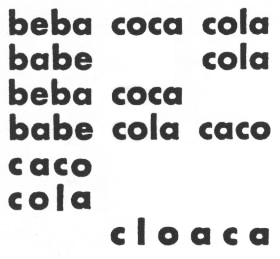
Décio Pignatari, Beba Coca Cola, 1957
pilot plan for concrete poetry (1958)1
concrete poetry: product of a critical evolution of forms. assuming that the historical cycle of verse (as formal-rhythmical unit) is closed, concrete poetry begins by being aware of graphic space as structural agent. qualified space: space-time structure instead of mere linear-temporistical development. hence the importance of ideogram concept, either in its general sense of spatial or visual syntax, or in its specific sense (fenollosa/pound) of method of composition based on direct – analogical, not logical-discursive – juxtaposition of elements. “il faut que notre intelligence s’habitue a comprendre synthetico-ideographiquement au lieu de analytico-discursivement” (apollinaire). eisenstein:ideogram and montage.
forerunners: mallarme** (un coup de des, 1897) : the first qualitative jump: “subdivisions prismatiques de l’idee”; space (“blancs”) and typographical devices as substantive elements of composition. pound (the cantos): ideogramic method. joyce (ulysses and finnegans wake) : word-ideogram; organic interpenetration of time and space. cummings: atomization of words, physiognomical typography; expressionistic emphasis on space. apollinaire (calligrammes) : the vision, rather than the praxis. futurism, dadaism: contributions to the life of the problem. in brazil: oswald de andrade 11890-1954) : “in pills, minutes of poetry”. joao cabral de melo neto (born 1920 – the engineer and the psychology of composition plus anti-ode) : direct speech, economy and functional architecture of verse.
concrete poetry: tension of things-words in space-time. dynamic structure: multiplicity of concomitant movements. so in music – by definition, a time art – space intervenes (webern and his followers: boulez and stockhausen; concrete and electronic music); in visual arts – spatial, by definition – time intervenes (mondrian and his** boogie-woogie series; max bill; albers and perceptive ambivalence; concrete art in general).
ideogram: appeal to nonverbal communication. concrete poem communicates its own structure: structure-content. concrete poem is an object in and by itself, not an interpreter of exterior objects and/or more or less subjective feelings. its material: word (sound, visual form, semantical charge). its problem: a problem of functionsrelations of this material. factors of proximity and similitude, gestalt psychology. rhythm: relational force. concrete poem, by using the phonetical system (digits) and analogical syntax, creates a specific linguistical area –** “verbivocovisual” – which shares the advantages of nonverbal communication, without giving up word’s virtualities. with the concrete poem occurs the phenomenon of metacommunication: coincidence and simultaneity of verbal and nonverbal communication; only – it must be noted – it deals with a communication of forms, of a structure-content, not with the usual message communication.
concrete poetry aims at the least common multiple of language. hence its tendency to nounising and verbification. “the concrete wherewithal of speech” (sapir). hence its affinities with the so-called** isolating languages (Chinese): “the less outward grammar the chinese language possesses, the more inner grammar inheres in it” (humboldt via cassirer). chinese offers an example of pure relational syntax, based exclusively on word order (see fenollosa, sapir and cassirer).
the conflict form-subject looking for identification, we call isomorphism. paralell to form-subject isomorphism, there is a space-time isomorphism, which creates movement. in a first moment of concrete poetry pragmatics, isomorphism tends to physiognomy, that is a movement imitating natural appearence **(motion) ; organic form and phenomenology of composition prevail. in a more advanced stage, isomorphism tends to resolve itself into pure structural movement (movement properly said); at this phase, geometric form and mathematics of composition (sensible rationalism) prevail.
renouncing the struggle for “absolute”, concrete poetry remains in the magnetic field of perennial relativiness. chronomicrometering of hazard. control. cybernetics. the poem as a mechanism **regulating itself: feed-back. faster communication (problems of functionality and structure implied) endows the poem with a positive value and guides its own making.
concrete poetry: total responsability before language, thorough realism. against a poetry of expression, subjective and hedonistic. to create precise problems and to solve them in terms of sensible language. a general art of the word. the poem-product: useful object.**
augusto de campos
décio pignatari
haroldo de campos
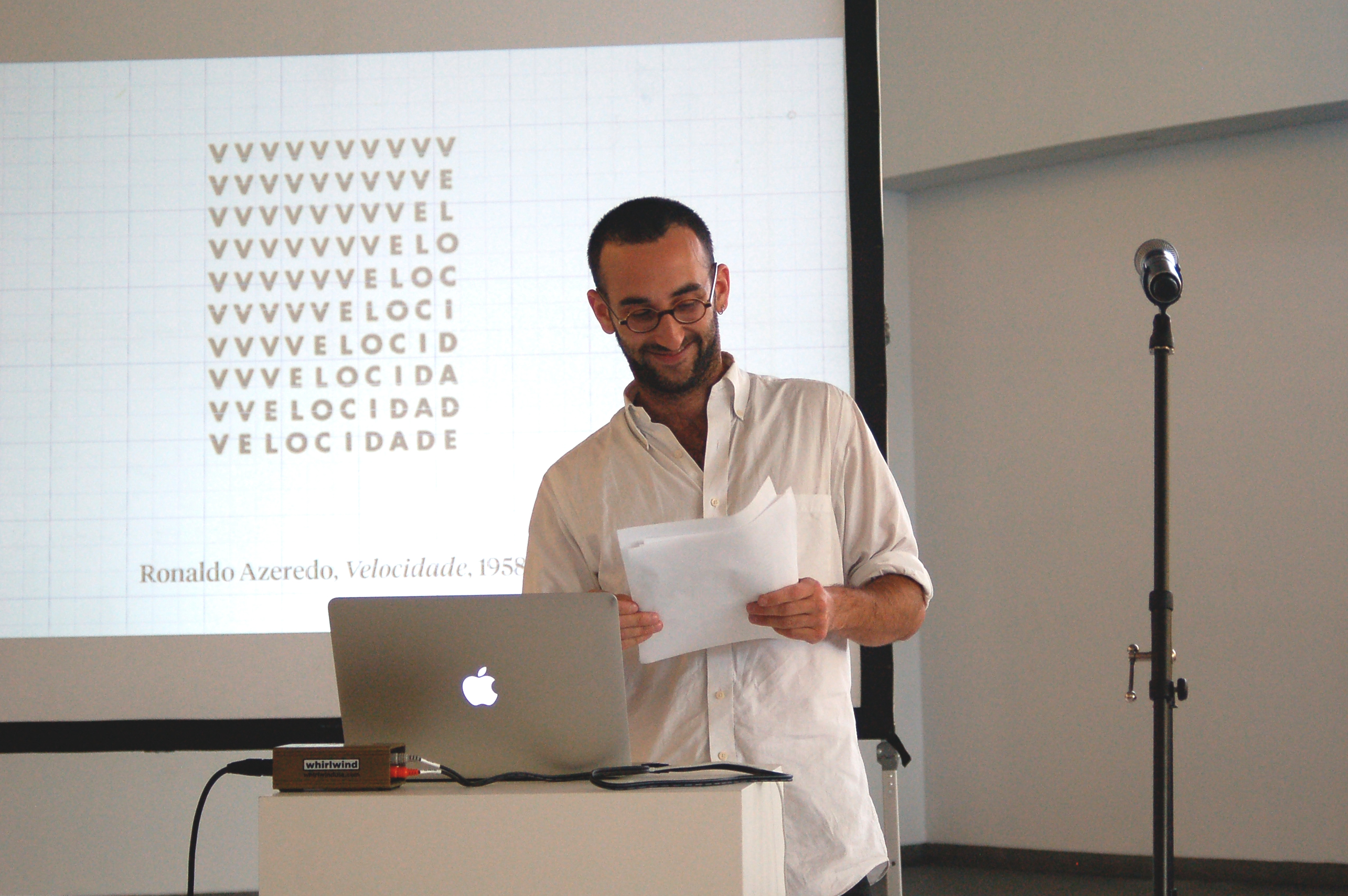
Nathaniel Wolfson reading Ronaldo Azeredo’s poem Velocidade (1958) at NADA 2015
The poems interspersing this article were performed by Nathaniel Wolfson on May 17, 2015 at the A+WS program at NADA 2015. The poems above are selections from the program, which featured six readings:
Haroldo de Campos, Nasce Morre (1958)
Décio Pignatari, Beba Coca Cola (1957)
Décio Pignitari, Terra (1958)
Augusto de Campos, Cidade-Cite-City (1963)
José Lino Grünewald, Pedra (1957)
Ronaldo Azeredo, Velocidade (1958)
Nathaniel Wolfson reading Décio Pignitari’s Terra (1958)
Concrete Poetry of the Noigandres was produced by Avant.org in association with AEROMOTO and Wendy’s Subway for NADA New York 2015. Further assistance was provided by Sonia Angela De Laforcade (Princeton University), Rachel Valinsky (Wendy’s Subway), and Sam Hart (Editor-in-Chief, Avant.org).
Thanks to Rachel Valinsky on behalf of AEROMOTO + Wendy’s Subway for the invitation to contribute to this wonderful library collection.
- English translation published as it originally appeared in Noigandres, No. 4 (1958)↥
Charles Eppley is an art historian and sound enthusiast living in Brooklyn, NY. He is a Ph.D. candidate in art history at Stony Brook University, where he researches the history of sound in modern and contemporary art. He currently teaches at Pratt Institute and works as a freelance writer and curator. Charles is an editor and programs director at Avant.org.
Nathaniel Wolfson is a Canadian writer. He is a Ph.D. candidate at Princeton University researching the tradition of Brazilian concrete art of the 1950s and 1960s with an interest in poetry and the many aesthetic and philosophical conceptions of “the concrete” with which it dialogued.


