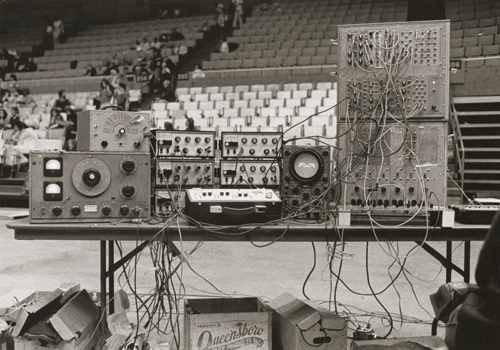
Liz Phillips is a pioneer in the development of electronic sound and environmental art. Her sound practice encompasses interactive sculpture and interactive installation with occasional excursions into performance and dance. Phillips’ works point toward a non-musical emergence for creative circuitry in art of the 1960s and 1970s, and specifically illustrate the interaction of homemade electronics with environmental practices. Her works, both in the gallery and in public spaces, also use responsive electroacoustic systems to highlight their connections to social issues and community-making, and transform the paradigm of the electronic circuit into one of the social circuit.
Charles Eppley spoke with Phillips about her experiences with electronic circuity, and the development of sound installation as an artistic practice. This interview is presented as part of our performance program Circuit Scores, which featured a discussion panel with Phillips, Julie Martin (Director, Experiments in Art & Technology), and members of Composers Inside Electronics.
Charles Eppley: How did you first get involved with electronic circuitry?
Liz Phillips: Well, I came totally out of sculpture, not out of music. First, I did a lot of ham radio stuff as a kid. I built little crystal radios and all that stuff. I was interested in sculpture and how to scale it to work with people moving around, tune it into where they were at, their size or speed. I was also interested in light changing on sculpture, how sculpture is corroded, how landscapes change over time, how a sand dune shifts with erosion, ecological changes. When you walk around a tree, it affects the earth, it affects what is living around the tree. I was interested in capturing that sort of thing in my artwork - the impression people make on a landscape.
I first worked with these metal objects and shreds of Mylar going into big metal circles and squares, which were situated in space. One of my first pieces in high school was like that, with lights shifting on it, and a pressure pad on the floor – the sounds of water, like a brook, running through the space were activated when you went in. The pad activated a recording that was playing on a looping tape. That was my first sound sculpture. But then I noticed the Theremin and also the lines on my television, which shifted when I went near and far from the device because of transmission interference. I thought “This is way more what I’m looking for…” I stuck my fingers inside of television sets to find the place where you could shift frequencies by movement, which I removed and wired onto metal plates.
CE: So you dissected preexisting technology –
LP: – to find oscillators that played between stations. I was in the country, in Vermont, so it was easy to find lots of [open] space with oscillator [signals]. There were no phase loops so [the signals] ran freely between stations. You could kind of harness them. I was also using traffic light timers, which are huge round spools, and setting them at different timings. I had big light-bulbs in ceramic fixtures all over the floor, and built little square wave oscillator circuits that corroded and broke apart as you shifted their pitch with a light sensor. I stuck them on the walls all around this giant carriage barn, and all of these lights in different sequences on the floor, the audience ran between and sort of danced between the screeching pitches.
CE: What year was that?
LP: 1969–1970. [The system] would hear one sequence of lights near it and then another far away. You could tune them to sound pretty neat. The pitch wasn’t musically tuned at all – it was pretty raw. I tuned it to the audio range and tried to tune them into each other.
CE: It’s interesting to think about this practice as an alternative emergence for the sort of circuit play beyond, say, the work of David Tudor and others. Rather than music, your electronics practice came from communications technologies and sounds that you sourced from broader engagements with circuity and [electromagnetic] capacitance fields: television, radio, traffic lights. Things that communicate information… but you [manipulated the] distortion of that information.
LP: Yeah - it’s really about sculpture, space and time. It’s interesting to work with technologies, but when I started there was nothing else. You have to understand that the army had most of the circuits. Some companies had infrared but it was very hard to get your hands on technology. You had to deconstruct things. I used automatic range finders to pick up where people were along lines: an ultrasonic tick that goes out and retrieves spatial information - echolocation. You can determine distance by the length of time it takes for the sound to return. What’s really interesting are sub-echoes. Computers weren’t fast enough at the time to pick up those trajectories, but now you could map a whole space in no time.
CE: Ultrasonic sensors don’t sound like something you could have found in a consumer electronics store. How did you come by these materials?
LP: I read a lot of popular electronics magazines and there were a lot of engineers whose brains I picked. I worked at the Riverside Research Institute in New York City, which was doing defense contracting [for the United States Government]. I was their artist-in-residence.
CE: Was that before the Bell Labs artist residency program?
LP: No – around the same time, or a little later - late 1960s. I was still in college when I started working there. The only artist who had been at Riverside before was Salvador Dali. He wanted to use their photography studio. They had amazing stuff - strobe lights, microphotography. I couldn’t stabilize the electromagnetic fields in my work. I started working there to get help.
CE: The fields you were making with radios and televisions?
LP: Capacitance fields - they can’t be stabilized, basically, and I didn’t know that. At the end of three months there, the engineers said, “Well, fifty physicists could write their thesis on why this should or shouldn’t work in what you’ve done, but we’re not that interested because it’s unstable.” Now there is a great interest in these fields. Everyone is using them with [touch] screens and such.
CE: It’s funny how technologies can sit dormant –
LP: – for years and years. This was hard science to deconstruct. Especially for engineers because as soon as you put a capacitance field in a metal box and ground it, you’ve lost your field. They were so used to building metal boxes for all of their circuits, they kept defeating the work.
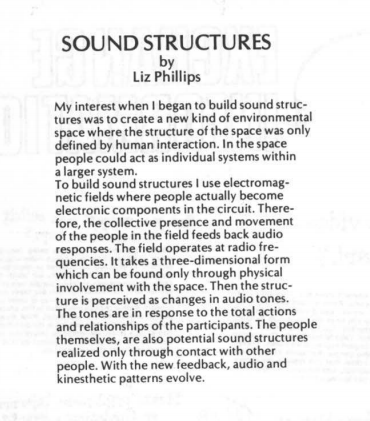
When you understand an open system, it begins to work better… as soon as I got to college, I studied with Thomas Standish, a Marxist economist at Bennington College who was into systems theory and macro-economics. [Standish researched how] a democratic system [could] turn itself over, which is exactly what I was looking for: to build pieces that varied over time and could completely transform themselves with audience input. He really understood the concept of open systems. I used social systems as models for open systems, hopefully making pieces that could become models for people to engage socially.
CE: In Circuit Scores we wanted to emphasize the concept of the social circuit - something of a metaphor for social action and interaction. In our program, we wrote about Experiments in Art and Technology and how [that project] is often characterized as technical innovation: that bringing art and technology together will create new materials or technical practices. However, a key interest of E.A.T. under Billy Klüver, Julie Martin - as well as you and Standish - was social interaction and community.
LP: That’s right. I would not have used electronic sound if not for sensors. I had no interest in making a piece that was composed from beginning to end and making people sit down and listen to it… if [the listener] couldn’t deconstruct and reconstruct sound, listen to parts and go back to those parts, then hear how they started and ended… without those events, I thought they would just hear sound as from another other world – space-age sound, no human understanding. If people couldn’t tactically engage with the piece, then it wasn’t interesting for me. I was interested in sound because it surrounded you and it was physical. Sound was a way to describe activity. I could show you videos from 1971 where the audience interacts with fields in space.
LP: I found the other day a really big old light sensor that I used in my early pieces. I was working at MIT Center for Advanced Visual Studies and and we’d go out into the country to these huge yards, huge buildings full of junk, piles of refuse electronics. I came back with microwave stuff, stuff that’s probably – stuff that said “Radiation: DO NOT TOUCH.”
CE: You probably came back with something else…
LP: I came back with monstrous stuff that had all these [warning] signs. I took anything that looked good: sensors and various boxes to take apart. I mean, at Riverside, I used gold-plated parts. They gave me two oscilloscopes. I was the only women who had ever been in the circuitry area, and the men were really pissed. They had all these pictures of naked girls on walls in the backroom. They gave me great parts, lots of help, so I was pretty lucky when I started. I got to know engineers who helped me make sense of what I wanted to build, and they brought me into these places.
CE: Presumably the engineers had some interest in your work?
LP: Well, they had several interests. This was during the Vietnam war - [there was] subversion - and they wanted to get engineers to think about things other than war and bombs. I was told many years later that the gold-plated (non-corrosive) parts were originally used to set off bombs at White Sands Missile Range, but it is important to note that I had only the minimum level of security clearance, certainly not enough to know military details. They really wanted to get better uses of technology, get their engineers to go in other directions, and I was good for that […]
things they never would have gone near in biotechnology, which was part of the progress, a brand new field.
CE: That’s interesting. The same might be said with Bell Labs. This interest in the arts was to some degree possibly altruistic or philanthropic –
LP: – but it wasn’t. It’s data visualization and, you know, speech recognition, data sonification. That was all pushed ahead by other interests.
CE: There is an ulterior motive to these art and technology engagements. The commodification of unused technology, militarization, surveillance.
LP: We were helping them as much as they were helping us. It’s always been that way. People don’t give you anything for free. [At Riverside], I was able to use a krypton laser. I could only stay for five minutes [at a time] and had to put on a lead vest. I could take a prism and spread any color of light, take the laser to color the room with a field of color. You could etch a dot or point on the wall, and spiral it out. Super powerful laser. I couldn’t take any pictures and had to leave quickly.
CE: Where was the building?
LP: It’s now Columbia University – the art and music building on 125th Street. When I was at MIT, that’s when I figured out, well, I better find my own lab. I learned a ton of technology picking the brains of engineers, but they got a lot out of me too.
CE: Can you describe some of the variables that you’ve used to define listener interactions?
LP: Broken/Unbroken Terracotta (1975) had a lot of them. There is a circular field, broken on the outside, a whole circle on the inside that is made of Mylar on the ground, and one field is radiated from that. The other is radiated from a band of copper coated aluminum that exists like a large flag, but it’s held up on four corners on strings. It stretches out along a wall parallel to the ground, slightly tilted, and curves so people of different heights will create different sounds. They could walk under and up to it, or from behind. It was exhibited at The Kitchen, placed between two columns, stretched. The piece had two freestanding omnidirectional loudspeakers, so I could carefully tune sounds that moved in between.
![]()
Nam June Paik interacting with Broken/Unbroken Terracotta (1975)
![]()
Broken/Unbroken Terracotta (1975)
![]()
Broken/Unbroken Terracotta (1975)
![]()
Broken/Unbroken Terracotta (1975)
![]()
Broken/Unbroken Terracotta (1975)
I built the whole circuit into a box that fit in a shoebox. It’s just a bunch of cards of oscillators – sine waves, voltage controls, modulators. I set tones for oscillators and modulators that fade one up and the other down, and go back and forth. When a body is in the center of the circle, they become balanced. One faded up in a sine wave, and the inverse of that sine wave faded the other up, so they would go up and down [together].
CE: So it registers the placement of the listener’s body.
LP: Yes – if you’re outside the circle, the sound starts to tilt, but when you go in the center, you get an even up and down. There are four tones playing. In the center, there was a very low frequency that would rise up for as long as you were still. It was a sample in voltage of how close you were to the other field. The concept was, well, “What is it like to throw a pot on the wheel and even out its flow back and forth,” so the wheel is spinning and getting all of these curves that you could shape with little bits of feedback. You shape the sine-waves. Most people think sine waves stay one shape but you can make it stay high longer and low longer. This sound rose up and could have a different shape based on where people were, how close, how fast; it would sample and hold the proximity.
CE: When you throw a vessel on the wheel, there is high probability of destroying it when you go to the outside, or apply pressure too quickly. If there is a sudden movement, the vessel sort of collapses.
LP: Exactly – the sound fields rippled. When you went near the other field, on another side, it would ripple with amplitude modulation. It’d get very loud and then fade out. You’d save those pitches… little bits of amplitude modulation under the sine waves would come in and… it was very hard to stay in tune. I’d tune it to the space. I’d never tune it ahead because how it sounded in a room, how long things last, how fast things come and go, this was all part of the tuning. In other words, nothing responded just in real-time. I would smooth out the response. The work followed you in one direction with a set of responses and fade. The great thing is that nobody used the piece to play pitches as if imitating a musical instrument, like a Theremin. They were dealing with time and space – proportions and balances.
CE: The idea of a tuned sonic environment suggests the relation of such practices in site-specific and environmental art of the 1960s and 1970s, broadly speaking. Your work seems like a great example of how in sound, not necessarily music, the conversation of site and place was simultaneously formulated.
LP: Yeah, and for me Broken/Unbroken Terracotta was a minimal piece. People like Steve Reich liked that piece, the very repetitive bouncing sounds, it was attractive to that kind of [minimalist] thing.
CE: How was it characterized by The Kitchen, which is still known for performance and music, rather than sound installation?
LP: It was really in between categories, which was a problem. They had to make the space available to me for a long time before to set it up and tune it to the space. It got a lot of press, so they liked that, and it got a lot of people. But it wasn’t typical at all of what was done at the space.
CE: Was it portrayed as a sound sculpture, minimal music, or sound environment?
LP: I think I called it a sound installation at that point. But, you know, my closest friends were video artists at the time. These people wrote about my work or plugged it into things like Charlotte Moorman’s Avant-Garde Festival – in that case, Paik. Beryl Korat put the piece in Radical Software magazine. The people I mostly hung with were video artists, as were most of the women I was closest to: Korat, Shigeko Kubota, Mary Lucier. These were women using technology and doing sculpture with video and information.
CE: How does circuitry intersect with environment in your work?
LP: Well, Cymbal (1985) really had the most visible circuits. It’s a piece that I tried to make completely transparent, so everyone could see the circuits as part of the piece. I’m not sure how successful that was. It scared the wits out of people to see all of the wires that it took to make the piece. Cymbal used six ultrasonics in a very large room – a commission for San Diego State University. The lines came out of a clear plastic soji panels and the circuits were right on the panels. Behind them was all of the analog circuitry and an Apple 2e that ran the system, so you saw everything, including little dots indicating where people were, mounted on the screen – little bitmaps.
CE: It was a surveillance piece!
LP: It’s interesting that you say that – the people who funded it had a private opening. They were a satellite company, one of the first cable companies. They had just sold the company and all of the executives and engineers had a party. They said “Hey, how did you learn how to do what we do?” Tracking motion, where people are going, moving, the trajectories… it was one of my first pieces with a computer running it. What was interesting is you saw all of the circuits and it was overwhelming to people. If they see the wires, they want to know what they are, where they are going, what they do, and that really is more alienating than helpful to see everything.
CE: Interesting. In comparison to your public installation City Flow (1977) where the circuitry is all hidden away –
LP: – you don’t see anything.
CE: This is how Max Neuhaus worked: you don’t show the stuff. You let people discover the environment. You found people were intimidated by the circuitry?
LP: The wires… exactly. They were totally alienated because they saw stuff and didn’t know how it worked – that’s all they thought about. It was crystal clear Plexiglass, freestanding walls… any movement changed an enormous amount of sound. It tracked people, sounds came and buzzed around you. I had quad-location–spinning sounds–so they’d buzz in your ear and follow you, bounce between people…
CE: With the installation Windspun (1981), one of the interesting things raised is the idea of community, the idea of engaging with electronics, which can be alienating, was actually part of the interest in engaging community.
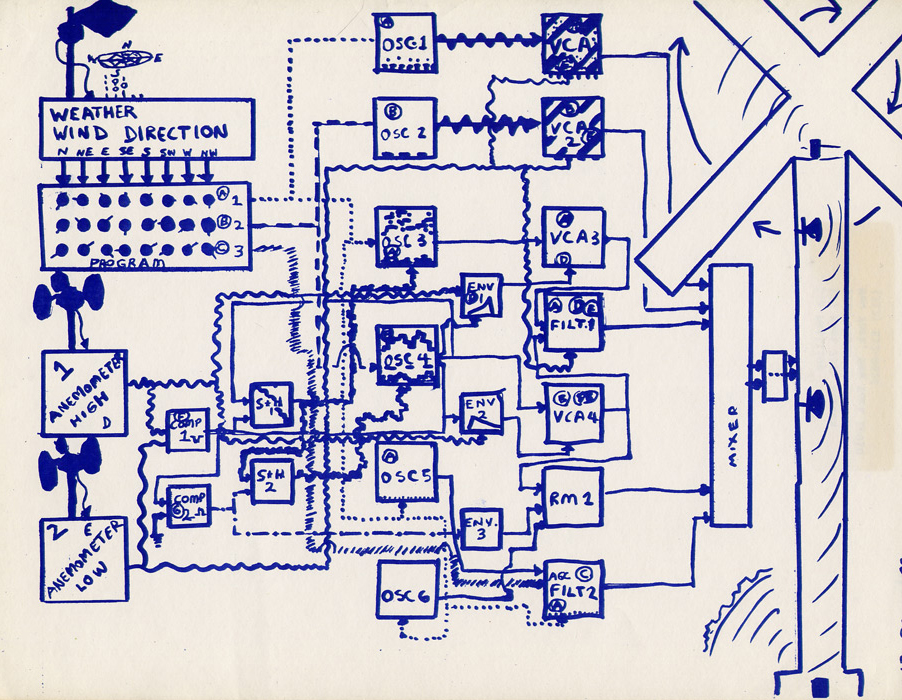
LP: In Windspun, you saw the anemometers, and they’d move – each time they would spin, you would hear a tone that went up and down, because they generate electricity. There were two of them and a weather vane, or so. The version in the Bronx was powered by a windmill, but you could still see the anemometers, but they didn’t really look at the electronics. You’d feel the wind hit you and [hear] the sound. But it wasn’t like wind chimes, which get faster and louder when there is lots of wind. I set it up so the slightest amount of wind activated sound. When the wind got faster, the sounds came in clusters, and pitches would shift.
LP: I was interested in wind energy and found the windmill. I hooked up with the Bronx Frontier Development Corporation, but what I couldn’t do was publicize the piece. I got funding and realized that Creative Time was the perfect group to help, so I brought them into the project. They made it fantastic. They brought people on a bus out to the South Bronx, out to this composting site, and critics out. They also made a beautiful poster, and all of that stuff, but the organization of the piece was totally between me and these people I knew who were into wind energy.
CE: There was a composting situation on site – and this engagement with environmentalism and community… what was your interest in this movement?
LP: I was interested in what was going on in this neighborhood that no one was going near. I mean, there were some downsides to working in a neighborhood like that, not the people, but wild dogs who would come and howl at the high pitches, you know, and a crowd would show up at night. You had to get off that site at night. There were other problems. The windmill was an experiment, and it was like running a giant truck with a Toyota brake system. When the wind got going fast, they had to lasso the blades to stop them, and they’d stop traffic on the East River.
CE: The windmill was taken down at some point?
LP: Yeah. The piece was taken down with it. The blade could cut loose and really spin.
CE: Do you see circuitry as socially oriented? Windspun created a nice intersection of new electronics, circuit-based sound practice, environmental installation, environmentalism as a movement…
LP: Yeah, it really worked. It was wonderful for me to study the wind. I learned a ton doing these different locations. I did the Whitney Museum. I did a Chicago water tower. I did one in Tulsa, Oklahoma for an arts festival. The first was in Minneapolis through a tornado watch during the New Music America festival in 1980. I got great winds. The more they switched directions, the more parts of the piece you heard. I was supposed to save Windspun for the Bronx, but Nigel Redden asked for a piece for NMA. He told me I could have Peavey Plaza, next to an orchestra hall, so I went for it. It was great – they have great winds. I put an anemometer on the water, and one way up high, and you could see the waves of winds come across this artificial lake. You could interact with it because I had a capacitance field, where people could play with the wind and interact on these stepping stones. I got to engage with a lot of kids who lived in the park, mostly native American kids who got way into it, and took care of the piece and helped out. That was the same in Tulsa. The Rainbow Collective kids, who lived in the parks, took care of my piece, day and night. I bought them food and they took showers at my hotel – whatever it took.
![]()
1980 NMA version of Windspun in Minneapolis
![]()
1981 Bronx version of Windspun in NYC
![]()
1981 Bronx version of Windspun in NYC
CE: The work raises a certain question of public monument, or anti-monument, and public sculpture. This usually means sculpture or something that is plotted down. Windspun is something more dynamic, formally and socially.
LP: The people at the Whitney – it was much harder. It was during the 1985 biennial and it was outside in the courtyard. I wired it from the roof, and the other anemometer was on the bridge, so you could see it [at the entrance]. The people who got into it were the people who lived or worked around there. The guy who ran the hotdog stand still offers me a free hotdog. I don’t usually want one.
CE: He’s still there?
LP: He just retired – really recently. Also, the guards got into it. The workers in the museum – I wired from top to bottom, so I got to know everybody. One guy told me about this incredible experience he had: a rainstorm hit and when the rain would stop and start the anemometers, or come in from the side, it created this incredible pizzicato effect, which never occurred to me. I never got to hear that. They all had different experiences. People would come up to me all the time telling me about what they heard. There was another guy on the maintenance crew who was a Vietnam vet, and wasn’t much interested in any of the art [at the museum]. He worked the nightshift and laid in the courtyard when the sun rose. In New York City, when the sun rises, the winds shift direction on the river. It happens on rivers and oceans, they come off the water and switch direction. So he would just lay there and listen to these shifts at sunrise.
CE: Your use of capacitance fields to build environmental, spatial sound situations is very linguistic in a way. The process seems to articulate some kind of information to the listener, who is listening but is also moving through the space and learns something. But it’s not as if you’re creating this field of sonic dynamics from a musical perspective, even experimental music.
LP: The concept is that sounds describe activity. If sounds describe activity well then they can become musical, but they are descriptive: sounds function as signal as well as music. If they just function as music, then everyone sits still. That happened sometimes - John Cage came into my studio and just sat still. He sat on the floor under a field and move the slightest bit to see what happened. He really didn’t want to be called on to move because he thought of it as performance. It wasn’t, but coming from his [musical] background, it felt like it if he had to move.
Cage loved the low frequencies at the edges of the field. He booked me for the Merce Cunningham 25th anniversary at the armory. Cage wanted me to work with him [on music], but I never wanted to…
CE: Why not?
LP: I felt that to take my sounds out of the place I was planning to put them was a ghost of the situation. I didn’t make pieces to be placed on tape or in random situations. The sounds I could make at that point – sometimes they sounded good – were mostly from oscillators. Oscillators can be beautiful when they’re finely tuned, but they didn’t stay finely tuned, and when I moved a piece it needed to be re-tuned. It would take ten days to properly set up a piece.
CE: That’s funny – a lot of people when they think of electronic music, or oscillators, they imagine something totally stable and perfectly pitched. They’re not…
LP: - especially if you have sensors controlling them.
CE: Right – they fall out of tune easily and get jostled around. This is the source of La Monte Young’s Drift Study (1969), the oscillators falling out of tune -
LP: - and having to fiddle with them. He is another one who begged me to work with him. He called me and asked me after I did Yoshi’s piece Earth Horns (1974). Allan Kaprow brought me out to CalArts and asked me to do a piece with him too, but I didn’t want to work with them. I suppose I could have gotten famous if I had worked with these people.
CE: There is something clear about not wanting to work with Cage or Young, because they’re musicians, but why did you want to avoid working with Kaprow?
LP: Well, you know, they just wanted my technology… but not with Cage. He actually wanted those low rolling sounds and to share sound. I couldn’t dispossess my sound from the pieces though… now people ask me for sounds and I give them. You want this sample of breaking glass? Here. Stretched? Here. Enjoy. You need ocean for your opera? OK. Raindrops… I have lots of it, but that’s different. It’s sampling and it’s much easier to save sounds now.
CE: What role does performance play in your work?
LP: I had a few extensions into performance. It was fun to work with other people, but I wasn’t really interested in performing - once in awhile someone got me involved. I met Alison because I lived in her house when Nam June Paik invited me to CalArts. I met her then and Yoshi through her when we got back to New York City. [I worked with Alison and Yoshi] on a piece called Sumtime (1968). It was an interesting idea: there was paint that retained light. They used it on the roads so it glowed at night.
CE: Highways?
LP: Yeah – I wanted a visual equivalent of what I was doing with sound. Sampling and holding things based on where you were in these fields. Alison saw work of mine like that using synthesizers at CalArts, and I suggested we paint a giant canvas and then have activity in front of it, with light flooding the space, leaving marks [behind]. I bought a big can of glow-in-the-dark paint and painted this huge canvas - forty or fifty feet. We called the piece Sumtime because we were adding up activities over time. Yoshi came into it because they worked together before and we wanted something that was performance, so he was perfect. The paint I used turned out to be radium paint. I got real sick. I don’t know what Alison did with the painting. I left it with her – we didn’t know what made it glow.
CE: Where did you buy this paint? It wasn’t regulated?
LP: No – not at the time. I bought it and got so sick. I had my appendix removed. I didn’t know that was why until later, when I realized it was the paint and an unventilated studio. Anyway, it worked pretty well. Alison’s idea was to set up hangers and clothes, and she wore a miner’s light on her head; she’d hold them and move them and do her poetry, ruminating while she moved around. My fields were also against that wall so she’d shift tones that were tuned into what Yoshi was playing. That was our first collaboration.
CE: Was Yoshi playing his metal horns?
LP: Giant horns. I tuned the fields so the pitches went with the Earth Horns.
CE: There is contrast between your passive fields – visual and optical – that respond to action, dynamic static fields, against Yoshi generating new sounds that are performed. You have a contrast of environment versus performance.
LP: We wanted something that existed over time. Yoshi’s stuff helped sustain the electroacoustic fields. We performed Earth Horns at the Nassau Coliseum with Yoshi and the Cunningham Company. David Behrman was running the sound. It was an amazing situation, and I didn’t think it would be because they had a mono system, but it was perfect. Spinning harmonics that arrived from modulations in that large space. Giant horns in the amphitheater. Fantastic.
CE: Yoshi recently performed Earth Horns at Emily Harvey.
LP: Yeah. His son Tashi is doing the electronics now.
CE: He used a small box that Bob Bielecki built to replace your large system. Where did that go?
LP: Well, my system came with me! At a certain point, I didn’t want to perform that piece many more times. I’m sure it didn’t fully replace what I did because I had a pretty complex system of envelope following the volume of the horns, and then bringing up these harmonics when there was less sound from the horns, which would amplify tones tuned to the instruments.
CE: Is that the only time you performed musically?
LP: Well, you know, I didn’t even really perform that piece musically either. I built a system and, in fact, the less I touched it, the better off it was… Basically, it performed itself by following those amplitudes and bringing up harmonics at different points, based on activity of the sound.
CE: I heard a rumor that Tudor once asked you to perform with one of your sculptures?
LP: Tudor didn’t ask me anything. Cage invited me to do three nights at the armory at 64th Street for the Cunningham anniversary. The other three nights were Tudor, Kosugi and Cage performing together. I was not invited by Tudor. In fact, Tudor would have liked to have had those solo nights, but Cage gave them to me for a piece that was commissioned by the Walker for his 60th birthday. Tudor and I had already sort of been in a slightly uncomfortable situation at the Soundings exhibition at the Neuberger in 1981. Rainforest was in the back room and it was loud as hell. I had my Sunspots in the front room, and there were no doors in between.
CE: Sound bleeding?
LP: Yeah - we got along fine but he didn’t like the idea that my installations played themselves. It was very popular with the public and his piece was in the back; he was doing his [resonant] objects, but was [also] amplifying them in speakers, even though it was playing out of the objects. It was really loud, a racket – and I loved it. He had performers playing and complained to me about his performers – they didn’t listen, they didn’t listen to each other, they’d go louder and louder, you know. He just couldn’t believe that I didn’t perform with the installation for the Cunningham company. If I had performed, then people wouldn’t know that the dancers were activating sounds and shifting them based on how they moved, how fast they went, and where they went. They would never know that if I was there turning knobs. They’d think I was just following the dancers. The dancers eventually, by the second night, especially Merce, were magical in moving sounds… the timing, locking in where he could do what, and shift sound. It was very quiet piece. Actually, the audience really liked it – that may have been the other problem. It was called Sonar Eclipse.
LP: Some of the really far out things about the armory architecture are the long distances. The echoes and delays. When you let go of ultrasonics in a space like that, things come back incredibly late – it’s beautiful what comes back from a tuned system.
CE: They were compounded?
LP: It’s not like being in a tiny little room and getting just the first echo. You get all these crazy sub echoes. I don’t think Tudor ever stayed to hear my piece, but he didn’t like the idea that my performance was an installation, activated solely by interactions of dancers with sensors. I have to say that when he did a piece with sensors, and he was turning all the knobs, and the sensors were functioning, it seemed that nobody knew what was happening. It might have been more musical, but it defeats the purpose. Why have the sensors?
CE: Is that because there is someone who seems to be performing – in complete control?
LP: They’re performing the sensors and nobody knows who did what, or whether they did it, or the performer did it. There is absolutely no transparency or translucency in the system.
CE: That reminds me of Robert Rauschenberg’s Soundings (1968), which is the namesake for both of the Neuberger and MoMA exhibitions. The piece has some sensor in it that registers viewer proximity, and it responds with preset lights that react to environmental sound.
LP: Slightly interactive. It was neat.
CE: Right – but it still is just on the wall, like a painting.
LP: People really have to explore how to change sound in my work. They have their own timing. I mean, with my earliest work, which was just a Theremin, people would shift it and try to play a tune on it. It was a disaster. I had no intention of showing it where you could do that, but some people threw it into shows before it was ready. As soon as I could use a synthesizer, I was out of that.
CE: There is a potential misunderstanding of, say, your installations. There is a possibility to think of using them as instruments, like a Theremin, which is used to mimic certain musical instruments or styles – and is also electroacoustic and electromagnetic. By using a more complex system and voltage circuits and things, can you prevent people from using your work in that way?
LP: The Theremin is a pretty bad instrument - and it is not about space, it’s about playing. It has no more space than a cello. It doesn’t give you an excursion of a base. My works are not instruments because they use time and smoothing circuits to create a fluid system, not a jittery nervous system. That’s sort of how Tudor worked – jittery kinetic systems. Don’t get me wrong – I had a breakthrough watching Tudor with Cunningham. I realized he had a way of spreading sound, coalescing sound, bringing it from one point and spinning it in different ways than I was doing, and it was very much closer to what the dance was doing. Tudor was much more tuned in to Cunningham’s events in some ways.
CE: There is something of a hyper masculinity that pervades creative sound practice, but particularly in electronics, electronics building, electrical systems. You mentioned having a conflict with Riverside engineers…
LP: Well, they didn’t want me down there. There were no other women in the technician lab, and many were not at all happy about my presence. The workers – not the high up engineers. The workers actually built the circuits. They didn’t want a woman in that area. It happens all the time. I had a hard time in Japan telling engineers that I needed a third ground for a piece. They didn’t want to take orders from a woman.
CE: What was this project?
LP: I put up a piece for IBM in Japan for their showroom – it was Sunspots (1982-84). I needed a real ground and they don’t have the same kind of electronic third prong ground [as in the U.S.A.]. We had a problem and I couldn’t get them to listen. Then they asked me for all of my circuits for an expo they were doing, and I wasn’t giving away my circuits, not in that way to someone who is going to go make a lot of money somehow. Guys like to think of themselves as pioneers. How often do they consider a woman to be a pioneer? It’s just not something that is contemplated. I hired a close friend, Kenny Greenberg, to help build my piece Echo Evolution (1999). He pointed out these neon lights where you can move gas in the tube using different levels. I told them what color.
When the curator came to write about the work, she insisted that he must have done all of the electronics, because he’s a guy. It’s still that way. If I have a show and have three students, and they’re like 19 or 20 male students standing in the room, maybe they’re watching it at the opening, and people come in and ask them how it works. They say “Ask her, she made it,” and they won’t ask the woman how it works. If there are guys around, they’ll be asked, and it’s assumed that somebody else did the technical work. It still hasn’t changed. There is really no reason why this has become the province of men, and it really isn’t in the rest of the world, because it’s actually women who are doing the labor of building most circuits. As far as designing circuits, where it came into people’s heads that women couldn’t hold four variable parameters in their heads, or build systems, I don’t know where that comes from either.
CE: There is some research into 1940s and 1950s radio culture and the HiFi system and the way that stereos, domestic electronics, homebuilt circuitry kits, functioned domestically to separate homes into gendered spaces.
Custom electronics fostered a kind of ‘man cave’ concept – a hideaway spot that reinforces something perceived as distinctly masculine.
LP: Yeah, I don’t get it. I built those kits and was into ham radio as a kid. I was the only woman in the ham radio shack.
CE: Exactly. I wonder if in artistic electronics and sound art this is sort of an extension of that cultural paradigm?
LP: I came up at the same time as Laurie Spiegel, Annea Lockwood, Pril Smiley, and Frankie Mann, well, she’s a little younger than I am. There were a dozen women doing electronic art at the same time that I was, and Maryanne Amacher, there were lots of us working with electronics. I don’t know how, you know, it’s this gender thing – the guys shared circuits with the guys. But Phil Edelstein built a lot of stuff of for me, as did George Lewis, when I needed help. Phil did it for very little money, if any, for years. When I had a baby and no focus, he helped build software that I needed. George did tons of stuff too.
I have to say that I have trouble keeping women in my classes on electronic art. The women sort of are making sculpture now, in metal, with wood, but they didn’t grow up with the toys where you put a circuit together, or putting kits together. They weren’t building motors and they have to catch up. When they enter my classes, often, there are tons of women who are totally denied from day one that experience of putting electronics together. I think that’s the problem. I don’t get it – why parents by their girls dolls, and buy their boys electronics kits. It starts really young.
CE: It’s a symptom of larger cultural patriarchy.
LP: Yeah – it’s very hard for me to understand. I haven’t given it a lot of thought but it is irritating when girls in my class, where I teach everyone to solder and to make amplifiers and wire transducers, a lot of women don’t know how to hook up a loudspeaker. That surprises me. They say, well, “He’ll do it for me, or someone will do it for me,” and I have to say “No, you have to do your own.” It’s very strange, even in college, I watch women who are totally capable of coding – and end up coding – start by getting someone to do the wiring.
CE: There does seem to be a more common tendency for women to code today, and to do software, rather than electrical engineering. It’s changing a bit on that front. But it seems the masculine legacy of American electronics culture is still pervasive.
LP: Maybe. I hope not. I have some really good students who are building everything, and they are women. But it’s tough – it’s not a very friendly situation. There have been a lot of good women who did not last in the field. Really good women. It’s still hard for women in bands… they don’t make it easy. It’s the nature of the culture. It’s a real issue still, but I think it will slowly change. What’s great is most of my favorite installation artists are women right now. There are all these women who are doing amazing stuff, besides the people of my generation - Sarah Sze and Shirin Neshat. Just great. Sze’s stuff could just as well be electronic in the way that it’s put together. There are young people doing amazing things, and, you know, installation art has always been a comfortable place for women, because they know how to make people comfortable in space, interactive space, social space. This is a province where women have a real history. Some of my students, who are writers but are also doing music and electronics, take my class and then get into coding, and they’re really happy with that stuff. Anything that plugs them in…
CE: Would you like to add anything else?
LP: I should tell you about the piece I’m working on at Governor’s Island. It’s based on the idea that if you could listen to the island, the way you listen to sound in a rowboat, and hear the waves hit it from all the sides… the tides, the waves, and listen underwater, you could start to hear that macro space and move it into physical human scale space, you could hear the tide shift and the underwater life on an island. Last week, Julie Martin sent me to an engineer. We went through a lot of technology for the piece – how to transmit signals from here to there on Governor’s Island, where there is no internet service or cellular service. I suggested we use mylar balloons filled with helium as antennas. They won’t be up that high – just above the trees so we can communicate.
Julie showed me a proposal that Tudor wrote for a similar island piece, but never got funding, some twenty years ago.
Not exactly the same, but basically trying to look at a whole island and its whole ecology, the water hitting it, and that’s what I’m trying to do there. Mostly, I’m using underwater sound and working with the New York Harbor School, and the Billion Oyster Project, which is taking oyster shells from major restaurants and putting them in the bay. They’re hoping to seedbed these oysters. They bring them up and count how many oysters are seeded on the shells. The harbor used to be full of oysters, and they’re great filters and cleaners of water. They’re trying to bring them back.
CE: It needs it, I’m sure…
LP: It’s real stinky, sooty stuff that comes up. It’s pretty shocking – a lot of mutated fish in the nets, but the sounds of oysters going in the water are great, as are all of the animals that interact with that environment.